Color: how white is white
The scale runs from D to Z. D has no color at all. Z has a light yellow or brown tint. The differences between neighboring letters are small enough that graders compare each diamond against master examples under controlled light.
| Grades |
Called |
What you will see |
| D, E, F |
Colorless |
No color, even to a trained eye |
| G, H, I, J |
Near colorless |
White to most eyes once the diamond is set |
| K, L, M |
Faint |
A soft warmth, more visible in larger diamonds |
| N to Z |
Very light to light |
A visible yellow or brown tint |
Beyond Z a diamond stops being "tinted" and becomes a fancy color, and the rules reverse: the stronger the yellow, pink or blue, the rarer it is.
The metal matters as much as the letter. Yellow gold lends its warmth to a diamond, so a near-colorless diamond looks white in it. A white setting shows a tint more plainly. Choose the two together.
Clarity: what the loupe finds
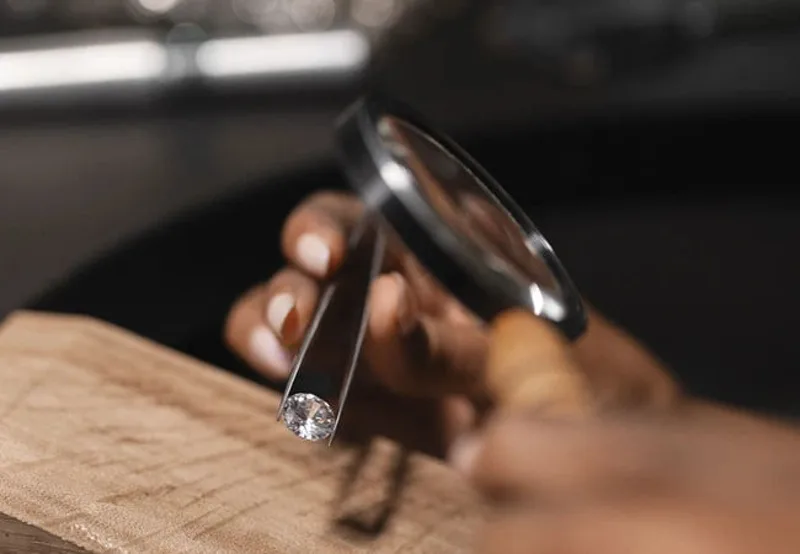
Almost every diamond carries small marks from its making. Clarity is the measure of how many, how large, and how easy they are to find at ten times magnification.
| Grade |
Name |
What it means |
| FL |
Flawless |
Nothing visible at 10x, inside or out |
| IF |
Internally Flawless |
Nothing inside; only faint marks on the surface |
| VVS1, VVS2 |
Very, very slightly included |
Minute marks, very hard for a skilled grader to find |
| VS1, VS2 |
Very slightly included |
Minor marks, seen with effort at 10x |
| SI1, SI2 |
Slightly included |
Noticeable at 10x, sometimes without it |
| I1, I2, I3 |
Included |
Obvious at 10x; may affect brilliance |
What matters on a hand is whether a diamond is eye-clean: nothing visible without the loupe. Many diamonds in the VS and SI grades are. The shape changes the answer. A round brilliant's busy facets hide small marks well. The long, open facets of an emerald cut show them, so clarity deserves more of the budget there.
Carat: weight, not size
One carat is 200 milligrams, divided into 100 points, so a 75-point diamond weighs three quarters of a carat. It is a weight and not a width. Two diamonds of the same carat can look different in size, because shape and proportion decide how much of that weight faces up.
Prices step up at the weights people ask for by name: the half carat, the carat, the two carat. A diamond just under one of those marks can look the same on the hand and cost noticeably less per carat. It is one of the few places in a diamond where there is something to be gained by knowing.
Reading the report
A diamond of any consequence comes with a report from an independent laboratory. It is the diamond's record, and it is worth five minutes of your attention before you fall in love.
Natural diamonds graded by the Gemological Institute of America carry all four grades as described here. Lab-grown diamonds are a different matter: since October 2025 the Institute describes eligible lab-grown diamonds as Premium or Standard, while IGI, another of the major laboratories, grades them on the 4 Cs. A lab-grown diamond is a diamond; it was simply born somewhere else. Just read the report from the laboratory whose name is on it.
What the paper cannot tell you
Four grades describe a diamond. They do not tell you which one makes your breath catch.
When the diamond is settled, How to Choose an Engagement Ring takes the rest of the decisions in order.
So come and look. We would rather put two diamonds side by side in your hand, under the same light, than ask you to take a letter's word for it. Bring the budget and the shape you have in mind to any of our three Tulsa showrooms, and we will show you what each of the four is worth to your own eyes.
 By Liz Sterling